
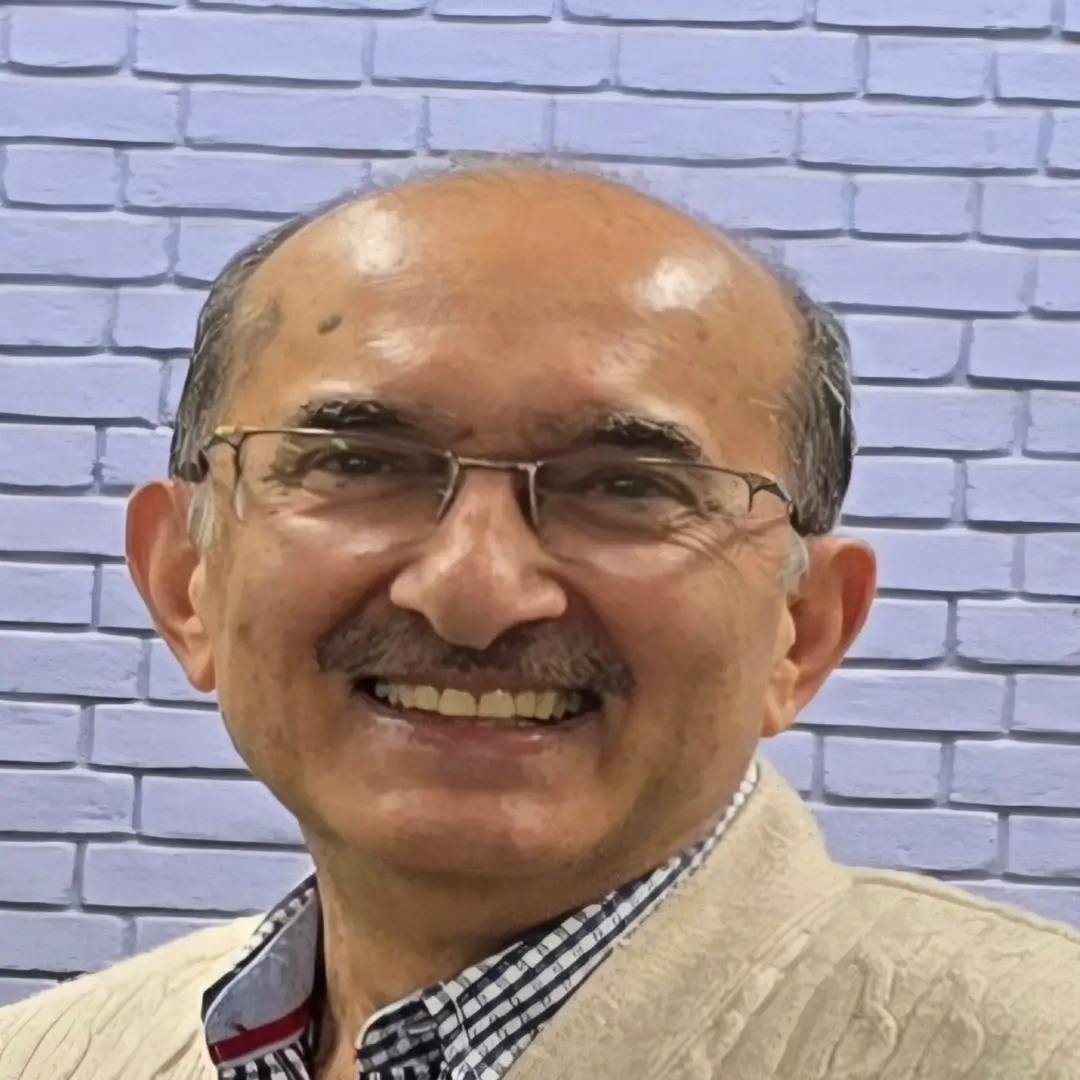
Author Interview: Rajiv Seth – Stolen from the Stars & An Echo from the Past
Both Stolen from the Stars and An Echo from the Past sit at the fascinating intersection of science, love, and human ambition. What was the original idea or question that sparked the creation of The Unforgiving Stars Duology?
The original question was simpler than it might appear: what is the most extreme thing grief can drive a brilliant person to do? I was thinking about loss – about how differently people metabolise it, about how some people transform grief into action and some into paralysis – and I found myself asking: what if the action that grief drove was not merely desperate but technically possible? What if the grieving person had both the knowledge and the access to do something the rest of humanity had agreed not to? That question produced Anjali. Anjali produced the novel. The novel produced Gagan. And Gagan produced the second book.
Anjali is driven by an extraordinary combination of scientific brilliance and deeply personal grief. How did you approach creating a protagonist who is simultaneously a doctor, a scientist, a lover, a mother, and ultimately someone willing to cross one of science’s greatest ethical boundaries?
I started with the grief and worked backward. A person in that depth of grief, with that level of capability, would not mourn passively – she would act. The question was what action was available to her that was commensurate with the size of the loss. Ordinary action – going into a shell, acceptance of ‘que sera sera’ – is not commensurate with the loss of the person who understood you completely (at least for Anjali). Only an extraordinary action could be commensurate. And the only extraordinary action available to a geneticist with laboratory access in the late 1990s was the one she took.
Everything else in Anjali’s character – the brilliance, the moral seriousness, the complicated relationships – had to be built to make the extraordinary action believable. She had to be someone we could imagine doing this. Not a villain, not a saint – someone we might have been, in that situation, with that knowledge.
The first book explores Anjali’s forbidden relationship with Aakash, while the second explores Gagan’s relationship with Maya. In many ways, love drives the major scientific and moral choices in the duology. Did you consciously intend love to be the force that pushes your characters toward both their greatest achievements and their greatest mistakes?
Yes. In Stolen from the Stars, love is possessive and defiant – it steals from destiny and defies cosmic rules. In An Echo from the Past, love is selfless and steadfast – Maya stays by Gagan’s bedside even when his memory and mind unravel. The duology showcases two faces of love: one that defies the universe to possess life, and one that holds a hand with infinite grace as life slips away.
Your own background spans aeronautical engineering, academia, scientific research, and the Indian Air Force. How much of your professional and scientific experience found its way into the novels, and did your background influence the way you approached the speculative science at the heart of the story?
Considerably – though perhaps not in the ways most immediately obvious.
The scientific rigour is the most visible debt. A mind trained in engineering does not easily accept vague or convenient science in fiction, and I spent real time in the genetics literature to ensure that the cloning science, the epigenetic pathology, and the neurological deterioration in both books are accurate to the best available research. The specific details – somatic cell nuclear transfer, methylation errors, telomere shortening and its effects on neural tissue – are not invented.
Less visibly, the military background influenced the moral architecture of the novels. The air force teaches you, very early and very directly, that decisions have consequences that outlast the moment of making them, and that the person who makes a decision is responsible for those consequences regardless of their intentions. That is Anjali’s situation exactly: the intention was love, the consequence was Gagan, and the responsibility is hers in full.
One of the most intriguing ideas in the duology is that cloning may be able to replicate biological identity without necessarily replicating the person themselves. What fascinated you most about the question of whether a human being’s memories, personality, consciousness, or even soul can truly be recreated?
Can we truly recreate? You can copy the hardware – the double helix, the blood type, the facial structure – but you cannot clone the cumulative, unpredictable journey of a human soul.
Gagan is recognisably Aakash in some deep biological sense – he has Aakash’s artistic sensitivity, his gentleness, his way of deflecting vulnerability through humour. But he is also entirely himself. Gagan is fundamentally his own person, trapped inside a vessel shaped by someone else’s past. The question the duology asks is not whether a clone is a true copy – clearly it is not – but whether the attempt to make one is a kind of hubris regardless of the result.
Gagan’s ‘Tenants’ and his experience of what appear to be genetic memories blur the boundaries between science and the inexplicable. How did you decide where to draw the line between science fiction, speculation, and the supernatural – and what did you want readers to question rather than definitively answer?
The Tenants are the one element of the duology that sits most clearly in the speculative rather than the established scientific literature. The idea that epigenetic inheritance might carry something like experiential memory – fragments of a predecessor’s neural patterns surfacing in a clone’s consciousness – is not currently supported by peer-reviewed science, but it is not outside the range of what researchers are asking about epigenetics. I wanted the Tenants to feel plausible rather than magical. I deliberately left their precise nature ambiguous. Aarika’s scientific explanation – epigenetic fragments, corrupted neural inheritance – is offered as a partial account, not a complete one. The novel never fully commits to the explanation, because I wanted readers to carry the question themselves: are the Tenants science, or memory, or something else? The uncertainty is the point. It mirrors our actual uncertainty about consciousness, about what a self is, and about how much of who we are is encoded before we begin.
The phrase ‘playing God’ carries enormous ethical weight in Stolen from the Stars. As someone with a strong scientific and academic background, where do you personally believe the boundary lies between scientific curiosity and scientific hubris?
I believe the boundary lies not in the act itself but in the question asked before it. Scientific curiosity asks: what is possible? Scientific hubris asks: what is possible for me, right now, to benefit myself or those I love? The shift from the universal to the personal is where the ethics changes. Anjali crosses that boundary – she uses a scientific capability that was developed for the general benefit of humanity to serve her own grief. That is the definition of hubris in the original Greek sense: not arrogance, but the use of power beyond what is owed to you. The stars, in the title, are the universe’s accounting system. They do not forgive the overreach. They simply present the bill and ask for payment.
The two novels span almost two decades and take the reader from AIIMS and genetic laboratories in England to Shillong and Coonoor. How important were these changing locations and time periods in shaping the emotional atmosphere and evolution of the story?
Entirely important – I do not think a novel of this kind can be set in abstracted space. The specific quality of Delhi in the 1980s – the particular social world of a government hospital, the class dynamics of a joint family in Greater Kailash, the general atmosphere of the Emergency’s aftermath – shapes who Anjali is and what she wants. Shillong’s specific geography – the hairpin bends, the pine forests, the particular mist that sits in the valleys – is not decorative; it is the environment in which Aakash’s character was formed, and it could not be anywhere else.
Coonoor serves a similar function for Gagan. The Nilgiris – their remoteness, their particular unhurried people, the way the mist comes in off the tea estates – is the landscape of a life deliberately hidden from the world. It had to be beautiful and slightly isolating simultaneously. Coonoor is both of those things.
Without giving away the ending, An Echo from the Past ultimately turns the question of human cloning from a scientific achievement into a deeply human tragedy. What did you want readers to take away about technological progress, responsibility, and the consequences of creating something simply because science makes it possible?
That ‘because we can’ is never sufficient justification on its own. That the consequences of scientific creation belong to the creator, regardless of how beautiful the intention was. And that the creation – whether a human clone, artificial intelligence, humanoid robots or any other entity brought into existence by human agency – could and will have a claim on the world that is entirely independent of the purposes for which they were created.
Gagan did not ask to be born. He did not choose his origin, his condition, or the clock running in his cells. He simply lived – as fully and as lovingly as his time allowed. The tragedy is not that Anjali created him. The tragedy is that she created him without being able to give him what he deserved: a life of sufficient length to live it properly. We might be asking the same question about artificially intelligent humanoid robots a few years down the line.
The title The Unforgiving Stars suggests a universe – or perhaps destiny – that does not easily forgive those who attempt to defy its laws. After taking Anjali and her story through such an extraordinary journey, what do you think the stars ultimately represent in the duology: fate, nature, destiny, or the limits of human ambition?
All four – and I would add a fifth: consequence. The stars are unforgiving not because they are cruel but because they are indifferent. They do not punish Anjali for what she did. They simply continue to operate according to their own laws, which she temporarily and brilliantly circumvented, and which eventually reasserted themselves through Gagan’s deteriorating cells.
The stars are the universe’s insistence on its own terms. You can steal from them – Anjali did, and the theft was real and the thing she stole was real and loved completely. But the debt is always presented. The account is always settled. That is what makes them unforgiving: not malice, but simply balancing of books.
Find the books at: